1996 DOW-UAP-D48, Department of the Air Force Report, 1996
DOW Investigation — Declassified UFO document from UFO Files Archive.
Document Details
- Agency
- DOW
- Type
- Investigation
- Classification
- UNCLASSIFIED
- Pages
- 116
- Date
- 1996
⚠️ AI-Generated Summary: This summary is generated from publicly released government documents for informational purposes only. Always refer to the original document linked above for the complete unredacted record.
Page 1 --- == \x16-== -=—=-\x17=------===—====-==-=—=-=-==-__;;;;._
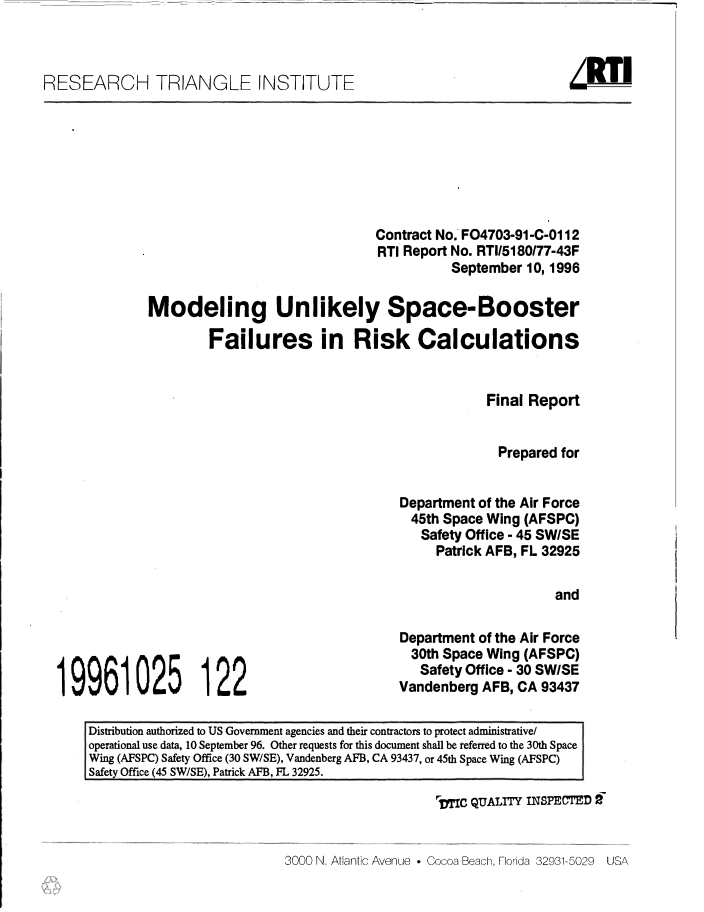
\ ____________ _ RESEARCH TRIANGLE INSTITUTE /RTI Contract No■-FO4703-91-C-0112
\ RTI Report No. RTl/5180/77-43F September 10, 1996 Mod…”
aiBriefing: ’## Document Overview
This is an unclassified final report from Research Triangle Institute (RTI), prepared for the U.S. Air Force 30th and 45th Space Wings, dated September 10, 1996. The document describes a methodology for incorporating unlikely space-booster failure scenarios into risk calculations for range safety.
Source: RTI Report No. RTI/5180/77-43F, title page and distribution statement.
What This Document Contains
-
The report was produced under Contract No. FO4703-91-C-0112, authored by James A. Ward, Jr. and Robert M. Montgomery of RTI’s Center for Aerospace Technology.
-
Its subject is the mathematical modeling of low-probability booster malfunctions (e.g., catastrophic failures) to support launch hazard analyses.
-
Distribution is restricted to U.S. Government agencies and their contractors to protect administrative/operational use data.
Source: Title page, report documentation page, and distribution statement.
Key Observations
No observations, sightings, or discussion of Unidentified Anomalous Phenomena (UAP) are present in this document. The content focuses entirely on risk assessment for space launch vehicles.
Source: Full OCR text; the document’s stated title and subject are “Modeling Unlikely Space-Booster Failures in Risk Calculations.”
Context & Significance
This report falls within the domain of launch range safety, a field that occasionally intersects with UAP research when anomalous objects are detected during space operations. However, this specific document does not address UAP, and its significance to UAP studies is limited to background information on how the Air Force assessed launch-related risks in the mid-1990s.
Source: Document’s stated purpose and intended audience.
Evidence Assessment
What this document shows:
- A technical methodology for quantifying risk from rare space-booster failures, as contracted by the Air Force Space Wings.
What this document does NOT show:
-
No mention or implication of UAP, unexplained aerial objects, or anomalous technology.
-
No connection to any incident reports or observational data beyond booster engineering.
[WARN] Assessment: This is a genuine, unclassified engineering report that contains no evidence or discussion relevant to UAP. Its presence in a UAP-related collection may be incidental or related to broader Air Force safety documentation.’ keyFindings: [] tags:
- DOW
- Investigation
- N/A
relatedFiles: []
featured: false
heroImage: /pdf-covers/dow-uap-d48-department-of-the-air-force-report-1996.png
documentType: Investigation
region: N/A
decade: 1990s
releaseBatch: Release 01
coverImage: /pdf-covers/dow-uap-d48-department-of-the-air-force-report-1996.png
archiveId: DOW-UAP-D48,_Department_of_the_Air_Force_Report,1996
warGovUrl: https://www.war.gov/ufo/#DOW-UAP-D48, Department Of The Air Force Report 1996
officialDescription: ”--- Page 1 --- == \x16-== -=—=-\x17=------===—====-==-=—=-=-==-__;;;;.
\ ____________ _ RESEARCH TRIANGLE INSTITUTE /RTI Contract No■-FO4703-91-C-0112
\ RTI Report No. RTl/5180/77-43F September 10, 1996 Modeling Unlikely Space-Booster
\ Failures in Risk Calculations 19961025 122 Final Report Prepared for Department
\ of the Air Force 45th Space Wing (AFSPC) Safety Office - 45 SW/SE Patrick AFB,
\ FL 32925 and Department of the Air Force 30th Space Wing (AFSPC) Safety Office-
\ 30 SW/SE Vandenberg AFB, CA 93437 Distribution authorized to US Government agencies
\ and their contractors to protect administrative/ operational use data, 10 September
\ 96. Other requests for this document shall be referred to the 30th Space Wing
\ (AFSPC) Safety Office (30 SW/SE), Vandenberg AFB, CA 93437, or 45th Space Wing
\ (AFSPC) Safety Office (45 SW/SE), Patrick AFB, FL 32925.” evidenceLevel: Historical Record hasUAPObservation: true mentionsPhysicalEvidence: true mentionsBiological: false ocrQuality: high
[WARN] AI-Generated Summary: This summary is generated from publicly released government documents for informational purposes only. Always refer to the original document linked below for the complete unredacted record.
Document Overview
This is an unclassified final report from Research Triangle Institute (RTI), prepared for the U.S. Air Force 30th and 45th Space Wings, dated September 10, 1996. The document describes a methodology for incorporating unlikely space-booster failure scenarios into risk calculations for range safety.
Source: RTI Report No. RTI/5180/77-43F, title page and distribution statement.
What This Document Contains
- The report was produced under Contract No. FO4703-91-C-0112, authored by James A. Ward, Jr. and Robert M. Montgomery of RTI’s Center for Aerospace Technology.
- Its subject is the mathematical modeling of low-probability booster malfunctions (e.g., catastrophic failures) to support launch hazard analyses.
- Distribution is restricted to U.S. Government agencies and their contractors to protect administrative/operational use data.
Source: Title page, report documentation page, and distribution statement.
Key Observations
No observations, sightings, or discussion of Unidentified Anomalous Phenomena (UAP) are present in this document. The content focuses entirely on risk assessment for space launch vehicles.
Source: Full OCR text; the document’s stated title and subject are “Modeling Unlikely Space-Booster Failures in Risk Calculations.”
Context & Significance
This report falls within the domain of launch range safety, a field that occasionally intersects with UAP research when anomalous objects are detected during space operations. However, this specific document does not address UAP, and its significance to UAP studies is limited to background information on how the Air Force assessed launch-related risks in the mid-1990s.
Source: Document’s stated purpose and intended audience.
Evidence Assessment
What this document shows:
- A technical methodology for quantifying risk from rare space-booster failures, as contracted by the Air Force Space Wings.
What this document does NOT show:
- No mention or implication of UAP, unexplained aerial objects, or anomalous technology.
- No connection to any incident reports or observational data beyond booster engineering.
[WARN] Assessment: This is a genuine, unclassified engineering report that contains no evidence or discussion relevant to UAP. Its presence in a UAP-related collection may be incidental or related to broader Air Force safety documentation.
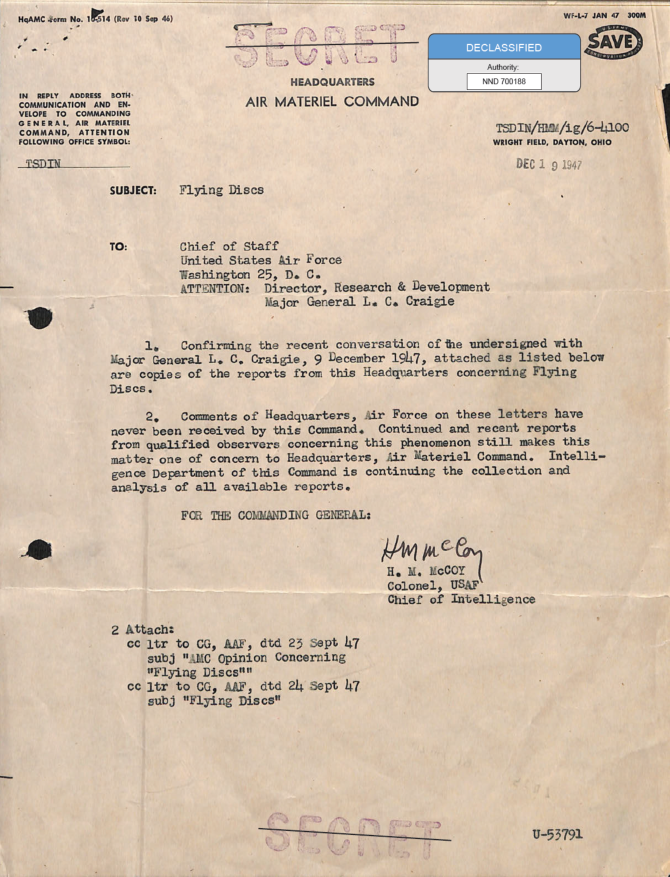
18 100754 General 1946-7 Vol 2
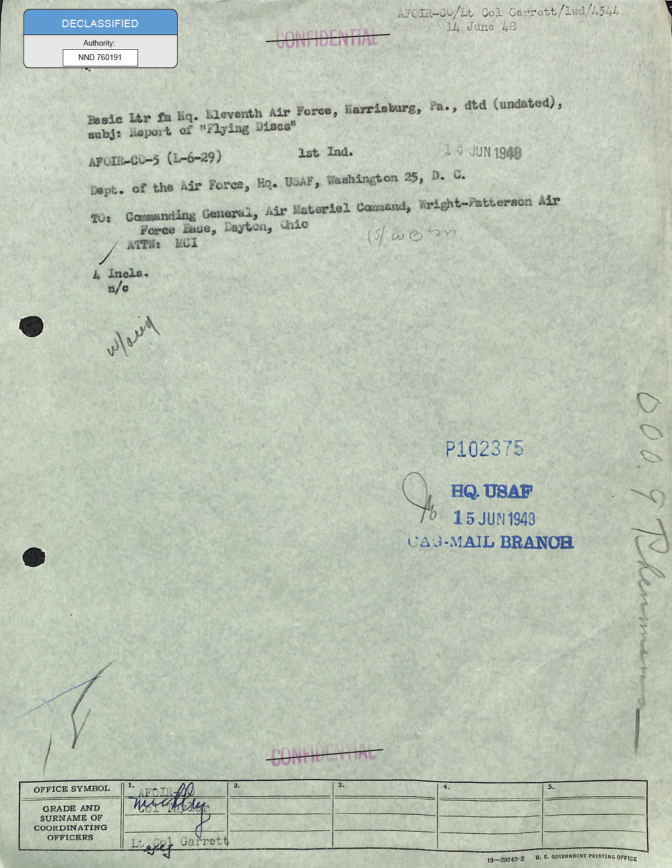
18 6369445 General 1948 Vol 1
255 413270 UFO's and Defense What Should we Prepare For
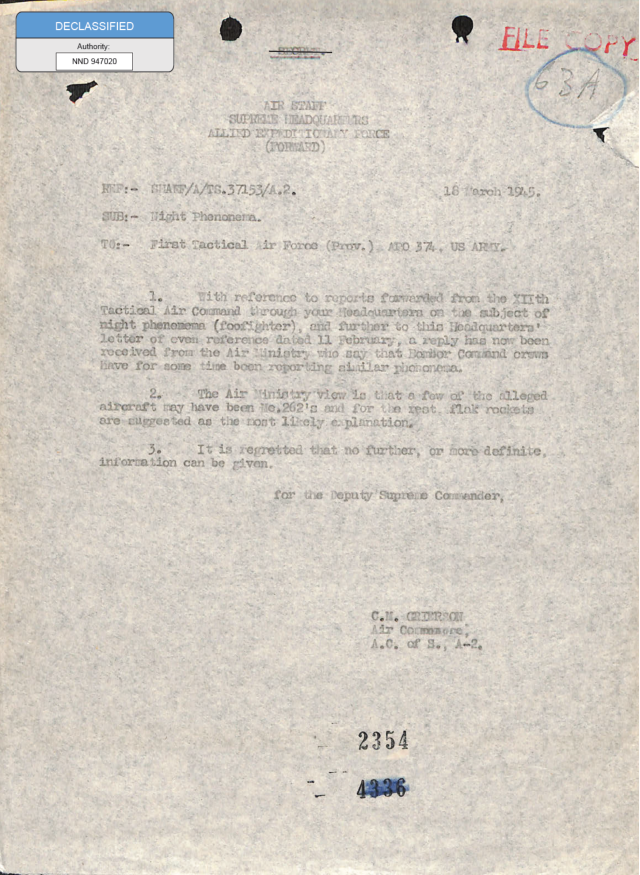
331 120752 Numeric Files 1944-1945 37153 German Armament Equipment Documents
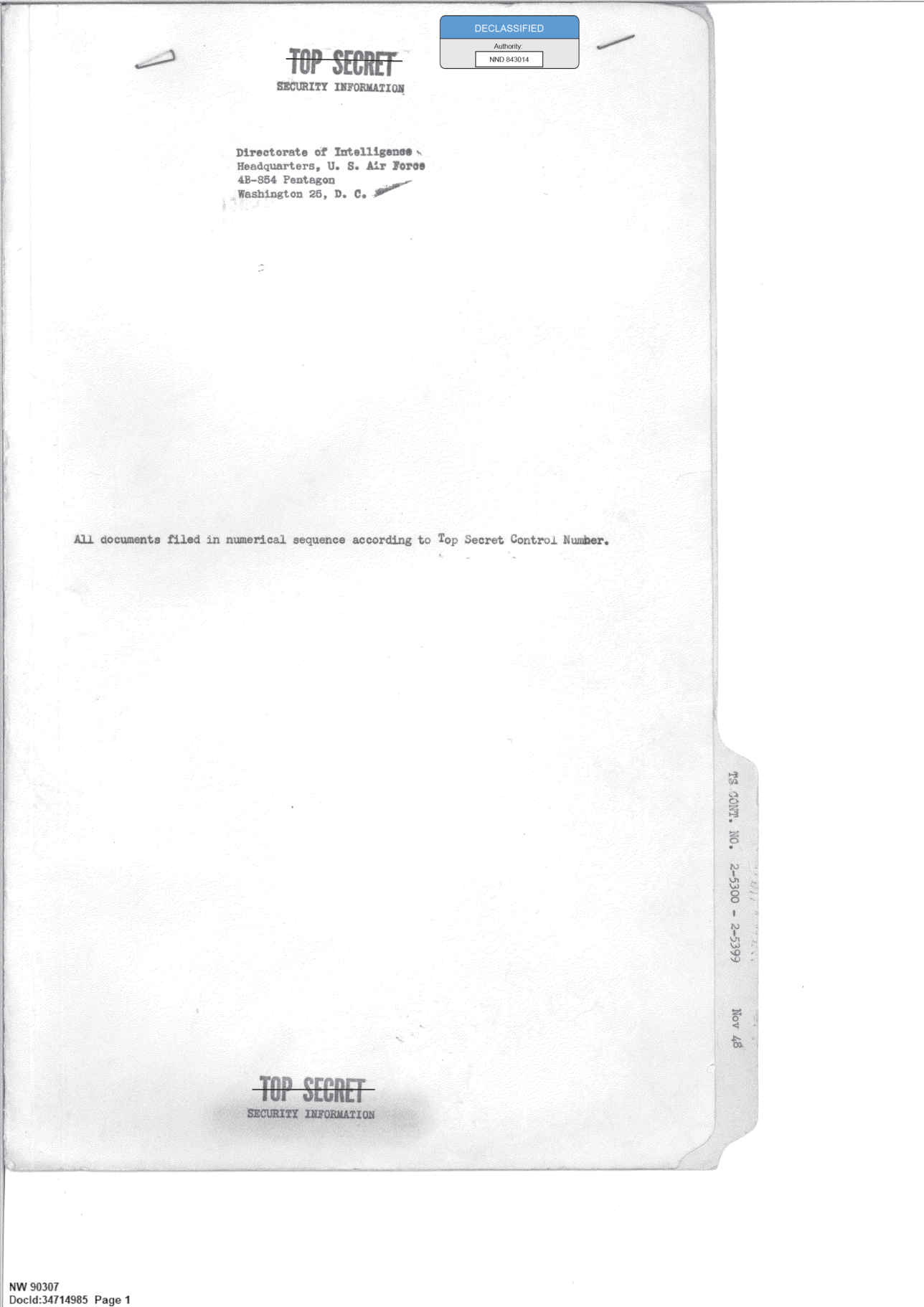
341 110448 Records Relating to the Collection and Dissemination of Intelligence 1948-1955-TS CONT No.2 2-5300-2-539