2016 DOW-UAP-D55, Mission Report, Syria, November 2016
DOW Mission Report — Declassified UFO document from UFO Files Archive.
Document Details
- Agency
- DOW
- Type
- Mission Report
- Classification
- UNCLASSIFIED
- Pages
- 1
- Date
- 2016
- Location
- Middle East
⚠️ AI-Generated Summary: This summary is generated from publicly released government documents for informational purposes only. Always refer to the original document linked above for the complete unredacted record.
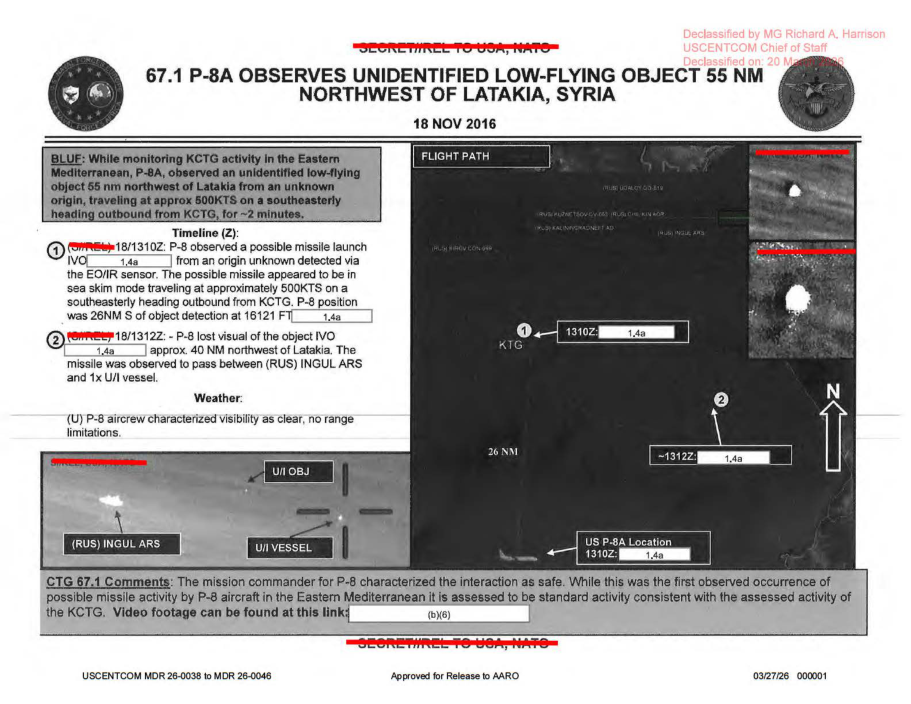
Page 1 --- Declassified by MG Richard A. Hamson USCENTCOM Chief of Staff Declassified on: 20 M~ 67.1 P-8A OBSERVES UNIDENTIFIED LOW-FLYING OBJECT 55 NM NORTHWEST OF LATAKIA, SYRIA 18 NOV 2016 FLIG…’ aiBriefing: ’## Document Overview
This document is a USCENTCOM intelligence report, declassified on an unclear date in March (“20 M~”), detailing a U.S. Navy P-8A Poseidon aircraft”s observation of an unidentified low-flying object northwest of Latakia, Syria, on 18 November 2016. It records the timeline, sensor detection, and preliminary assessment that the object was likely a missile launch associated with the Russian Kuznetsov Carrier Task Group (KCTG).
Source: Document title “P-8A OBSERVES UNIDENTIFIED LOW-FLYING OBJECT 55 NM NORTHWEST OF LATAKIA, SYRIA 18 NOV 2016,” declassification header, and OCR text, page 1.
What This Document Contains
-
A timeline (Zulu) from 1310Z to 1312Z on 18 November 2016, noting an EO/IR sensor detection of an unidentified low-flying object or possible missile traveling at approximately 500 knots in sea-skim mode on a southeasterly heading outbound from the KCTG.
-
Details of the P-8A”s position relative to the object, loss of visual contact at roughly 40 nautical miles northwest of Latakia, and the object”s passage between a Russian vessel (RUS INGUL ARS) and an unidentified vessel.
-
A mission commander assessment characterizing the interaction as safe, noting it as the first P-8 observation of such activity in the area, but concluding it was “standard activity consistent with the assessed activity of the KCTG.”
Source: OCR text, page 1, including timeline annotations and “CTG 67.1 Comments” section.
Key Observations
-
“P-8A OBSERVES UNIDENTIFIED LOW-FLYING OBJECT 55 NM NORTHWEST OF LATAKIA, SYRIA”
-
“P-8 observed a possible missile launch … detected via the EO/IR sensor. The possible missile appeared to be in sea skim mode traveling at approximately 500KTS on a southeasterly heading outbound from KCTG.”
-
“P-8 lost visual of the object … approx. 40 NM northwest of Latakia. The missile was observed to pass between (RUS) INGUL ARS and 1 x U/1 vessel.”
Source: OCR text, page 1.
Context & Significance
The report reflects routine U.S. naval intelligence collection during the Russian Kuznetsov carrier group’s Eastern Mediterranean operations in late 2016. The sighting was rapidly assessed as a probable missile launch—consistent with known naval exercises—and there is no indication of anomalous performance, unknown origin, or enduring mystery. The document underscores how ambiguous sensor contacts in contested environments are quickly contextualized based on operational patterns.
Source: OCR text, page 1, and declassification header indicating subsequent release for records.
Evidence Assessment
What this document shows:
-
A P-8A aircraft detected an object via EO/IR initially described as a possible missile traveling at high speed in sea-skim mode; its path and proximity to Russian vessels led analysts to assess it as a standard missile launch from the KCTG.
-
The aircrew characterized visibility as clear, and the mission commander deemed the encounter safe and consistent with expected task group’ keyFindings: [] tags:
-
DOW
-
Mission Report
-
Middle East relatedFiles: [] featured: false heroImage: /pdf-covers/dow-uap-d55-mission-report-syria-november-2016.png documentType: Mission Report region: Middle East decade: 2010s releaseBatch: Release 01 coverImage: /pdf-covers/dow-uap-d55-mission-report-syria-november-2016.png archiveId: DOW-UAP-D55,_Mission_Report,_Syria,_November_2016 warGovUrl: https://www.war.gov/ufo/#DOW-UAP-D55, Mission Report Syria November 2016 officialDescription: ’--- Page 1 --- Declassified by MG Richard A. Hamson USCENTCOM Chief of Staff Declassified on: 20 M~ 67.1 P-8A OBSERVES UNIDENTIFIED LOW-FLYING OBJECT 55 NM NORTHWEST OF LATAKIA, SYRIA 18 NOV 2016 FLIGHT PATH J!!Jlf: Whtie monitoring KCTG activity In the Ea•tem Mediterranean, P-IA, obe•rved an unidentified low-ftylng object 86 nm northweet of Latakla from an unknown origin, traveling at approx SOOK.TS on a •outheut•rly heading outbound from KCTG, for ~2 minutes. Timeline (Z): (D (°ell P”IEl!sto18/131 OZ: P-8 observed a possible missile launch IVQ 1.4a Ifrom an origin unknown detected via the EO/IR sensor.’ evidenceLevel: Sensor Data hasUAPObservation: true mentionsPhysicalEvidence: false mentionsBiological: false ocrQuality: high
[WARN] AI-Generated Summary: This summary is generated from publicly released government documents for informational purposes only. Always refer to the original document linked below for the complete unredacted record.
Document Overview
This document is a USCENTCOM intelligence report, declassified on an unclear date in March (“20 M~”), detailing a U.S. Navy P-8A Poseidon aircraft’s observation of an unidentified low-flying object northwest of Latakia, Syria, on 18 November 2016. It records the timeline, sensor detection, and preliminary assessment that the object was likely a missile launch associated with the Russian Kuznetsov Carrier Task Group (KCTG).
Source: Document title “P-8A OBSERVES UNIDENTIFIED LOW-FLYING OBJECT 55 NM NORTHWEST OF LATAKIA, SYRIA 18 NOV 2016,” declassification header, and OCR text, page 1.
What This Document Contains
- A timeline (Zulu) from 1310Z to 1312Z on 18 November 2016, noting an EO/IR sensor detection of an unidentified low-flying object or possible missile traveling at approximately 500 knots in sea-skim mode on a southeasterly heading outbound from the KCTG.
- Details of the P-8A’s position relative to the object, loss of visual contact at roughly 40 nautical miles northwest of Latakia, and the object’s passage between a Russian vessel (RUS INGUL ARS) and an unidentified vessel.
- A mission commander assessment characterizing the interaction as safe, noting it as the first P-8 observation of such activity in the area, but concluding it was “standard activity consistent with the assessed activity of the KCTG.”
Source: OCR text, page 1, including timeline annotations and “CTG 67.1 Comments” section.
Key Observations
- “P-8A OBSERVES UNIDENTIFIED LOW-FLYING OBJECT 55 NM NORTHWEST OF LATAKIA, SYRIA”
- “P-8 observed a possible missile launch … detected via the EO/IR sensor. The possible missile appeared to be in sea skim mode traveling at approximately 500KTS on a southeasterly heading outbound from KCTG.”
- “P-8 lost visual of the object … approx. 40 NM northwest of Latakia. The missile was observed to pass between (RUS) INGUL ARS and 1 x U/1 vessel.”
Source: OCR text, page 1.
Context & Significance
The report reflects routine U.S. naval intelligence collection during the Russian Kuznetsov carrier group’s Eastern Mediterranean operations in late 2016. The sighting was rapidly assessed as a probable missile launch—consistent with known naval exercises—and there is no indication of anomalous performance, unknown origin, or enduring mystery. The document underscores how ambiguous sensor contacts in contested environments are quickly contextualized based on operational patterns.
Source: OCR text, page 1, and declassification header indicating subsequent release for records.
Evidence Assessment
What this document shows:
- A P-8A aircraft detected an object via EO/IR initially described as a possible missile traveling at high speed in sea-skim mode; its path and proximity to Russian vessels led analysts to assess it as a standard missile launch from the KCTG.
- The aircrew characterized visibility as clear, and the mission commander deemed the encounter safe and consistent with expected task group
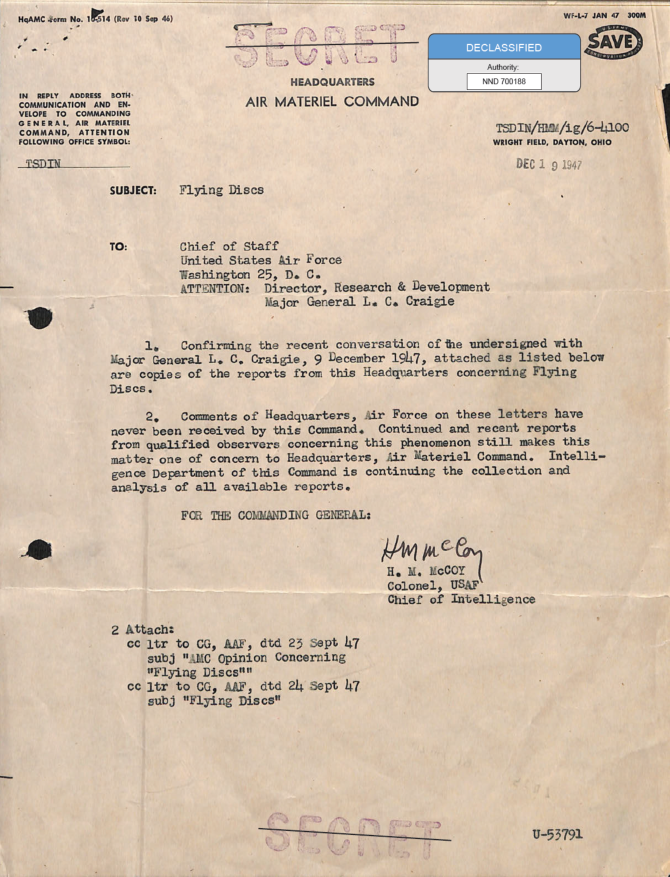
18 100754 General 1946-7 Vol 2
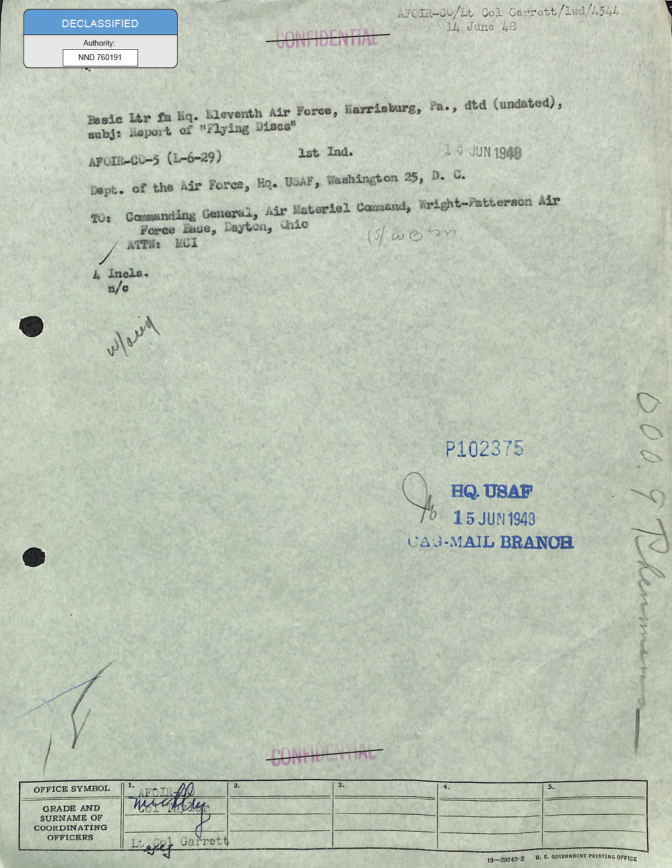
18 6369445 General 1948 Vol 1
255 413270 UFO's and Defense What Should we Prepare For
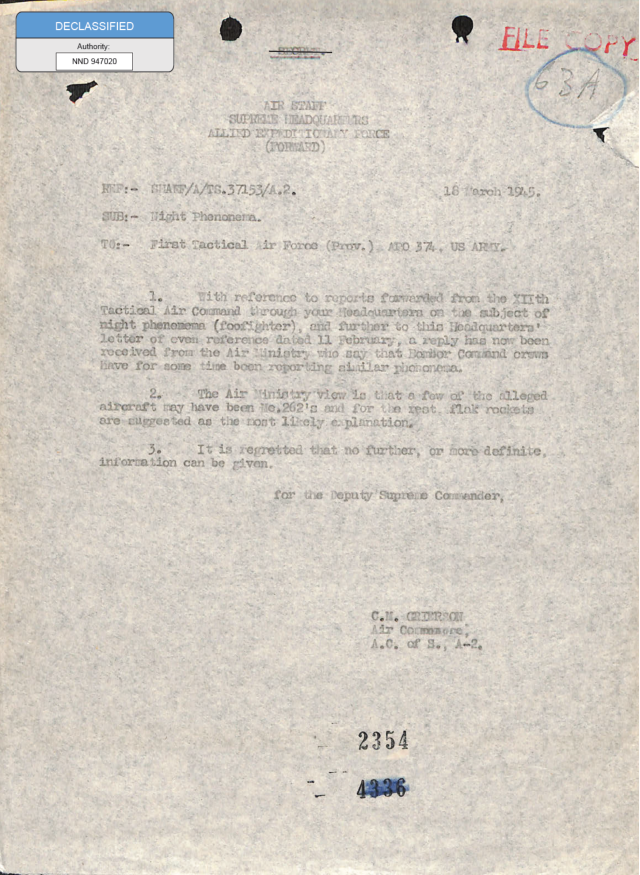
331 120752 Numeric Files 1944-1945 37153 German Armament Equipment Documents
341 110448 Records Relating to the Collection and Dissemination of Intelligence 1948-1955-TS CONT No.2 2-5300-2-539